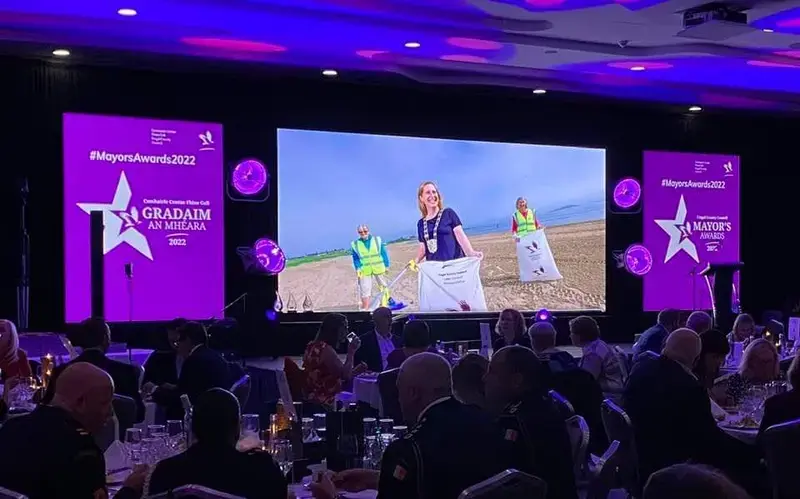
An awards night needs five things technically: a stage and lectern the whole room can see, a screen for nominee and winner slides, sound for the host, the winners and the walk-up music, lighting that separates the stage from the dinner, and someone running cues against the running order. Get those right and the night feels easy. Get one wrong and everyone remembers it. This guide is for whoever is organising a company, industry, council or club awards night, often for the first time. It follows the decisions in order, with the failures to plan out. If you're weighing up full event production for the night, it also shows what the brief should cover.
What an awards night is, technically
An awards night is two events in one room. For two hours people eat and talk. Then the ceremony starts and everyone turns their chairs towards a stage. The AV has to serve both and switch between them cleanly.
Unlike a conference, it's short bursts: a host, a name, a slide, music, a walk, a thirty-second speech, applause, repeat. The technical risk sits in the transitions. Each one is a cue, and each cue needs someone who knows it's coming.
The stage: what people can see and how they get there
Guests at a seated dinner look at the stage from chairs at round tables. A low stage means the back of the room sees heads, not winners. Go higher than feels necessary, then check the sightline from the furthest table. Low ceilings limit the height, so ask the hotel for the ceiling height early.
Steps matter more than people expect. Winners are often in evening wear and heels, and some carry a trophy back down. Steps should be wide, shallow and lit. Our modular staging is TUV-certified and comes with steps, safety rails and skirting, so the stage front looks finished. Pipe and drape and star cloth can dress the back and sides.
Make three placement decisions deliberately:
- The lectern. Put it to one side, not centre, so the host doesn't block the screen.
- The screen. Beside or behind the stage, high enough that nobody at the front table blocks it.
- The walk. Measure from the farthest table to the steps. A long walk through a crowded ballroom adds dead air.
The screen and its content
For an awards night the screen carries the structure. It shows the category, the nominees, the winner and the sponsor. During dinner it can run a sponsor loop or a welcome slide so the room never looks blank.
Screen size follows the room. Individual screens from 43 to 98 inches suit smaller rooms and side screens. Our LED walls start at 6 m², and the LED screen or LED wall guide explains which fits which room. The LED video walls page covers sizes and panel options.
Real jobs show the range. We provided an LED wall and lighting for the Mayors Awards in Dublin, and an LED screen for the Music Awards at the Hillgrove Hotel in Monaghan.
Content is where most awards nights go wrong, so be strict about it:
- One format. Ask for all slides in one file, one aspect ratio, one template. Slides from six people in six formats is the quickest route to a broken show.
- Early, with a hard cut-off. Slides should arrive well before the day, not on a USB stick at the door. Agree a cut-off and name who owns the file.
- Check winner slides. Whoever holds the results should check them against the slide order, line by line, before doors open.
- Sponsor loops are separate. Keep them in their own file so they can run during dinner without disturbing the ceremony.
Keep text large and short. People read it from a long way off, over a plate of food.
Sound: the host, the winners and the back of the room
Sound is harder at an awards night than at a conference, because the room has been talking for two hours. Speech has to cut through that.
We use professional line array and point source PA systems, with wireless microphones including handheld and lectern types. For a ceremony, think in roles:
- The host needs a reliable wireless handheld or headset, and a spare ready to go.
- The lectern carries presenters and sponsors who read from notes.
- Winners speak at the lectern or a handheld. Decide which in advance, so nobody fumbles at the stand.
- Walk-up music needs its own playback, levelled so it lifts the room without drowning the host.
The hard part is intelligibility. A ballroom full of round tables and people is noisy. The speakers need to cover the back tables as well as the front, and levels should be checked from the far end during setup, not just from the stage.
Lighting: stage and dinner as two different looks
Lighting separates the two halves of the night. During dinner you want the room warm and the faces visible. For the ceremony, the stage needs to be brighter than the room, so the eye goes where the action is.
Our lighting includes intelligent moving heads, LED uplighting, wash lighting, follow spots, pin spots and gobo projection, controlled on Chamsys. A simple awards rig needs only a few of those. A stage wash lights the host and winners evenly. Uplighting colours the walls so a plain ballroom looks designed. A follow spot picks out a winner on the walk. Our lighting design page lists the options.
Think in looks, not fixtures: dinner, ceremony and finale. Each is a stored lighting state, called at the right cue. The change from dinner to ceremony should be gradual enough that nobody flinches.
The running order and the cue sheet
The running order is the document the whole technical team works from. It lists every item in sequence, with timings, who speaks, what plays on screen and what music cues in. A cue sheet for the technical team adds the lighting state, slide number and microphone for each beat.
Three habits help:
- One master copy. Every change goes into one document, and one person updates it.
- A cut-off. The running order usually keeps changing until the final days, so agree a date after which changes need the organiser's sign-off.
- One person calls the show. Someone, usually a stage manager or producer, says "go" for each cue so sound, lights and screen change together.
If your supplier is quoting a fully operated night, ask who runs the cues. Our quotes include on-site operation, with no hidden fees. Our conference AV costs guide explains how that kind of quote is built.
Rehearsal on the day
You rarely get a full dress rehearsal, but you can get a useful one. Before doors, do a technical run: walk the host through the first and last cues, test every microphone on a real voice, play the walk-up music at show level and run a few winner slides through the screen.
Ask someone to sit at the farthest table and tell you whether they can hear and read. Then reset everything to the opening state.
The common failures and how to prevent them
| What goes wrong | How to prevent it |
|---|---|
| The wrong winner slide appears | One master results file, checked against the slide order before doors, and one person who owns both |
| Late changes to the running order | A cut-off date, one master copy and a named person who signs off changes |
| A long walk to the stage | Measure the route, clear the aisle and consider a follow spot to guide the winner |
| Speeches nobody hears at the back | Check levels from the far tables during setup and brief winners to hold the microphone close |
| Photographer and stage light fight each other | Agree where the photographer stands and avoid flash into the follow spot or the screen |
Frequently asked questions
What AV does an awards ceremony need?
A visible stage and lectern, a screen for the nominee and winner slides, sound for the host and winners, lighting for the stage and the room, and someone to run the cues against the running order.
Is the hotel's own screen and PA enough?
Sometimes, for a small dinner with a short ceremony. Hotel systems are usually built for speeches, not slides, music and walk-ups timed to cues. Ask what the room has, who operates it and how it copes at the back of a full ballroom. We integrate with existing house rigs in venues nationwide, so you can keep what works.
Can the night be filmed or streamed?
Yes. We offer multi-camera filming, IMAG (live camera feed on the screens) and streaming to YouTube and Vimeo. Decide early, because cameras need positions that your seating plan and lighting must allow for.
A planning checklist you can copy
- Confirm the ceiling height and the furthest table from the stage
- Decide stage height, steps and lectern position
- Choose screen size and position, and check the sightline from the back
- Set one slide format and a cut-off date for content
- Name one person who owns and checks the results
- List microphones: host, spare, lectern and winners
- Agree walk-up music and who plays it
- Plan lighting looks for dinner, ceremony and finale
- Write the running order, set a cut-off and name who calls the cues
- Book a technical run before doors
- Agree where the photographer stands
- Decide whether the night is filmed or streamed
Planning your awards night
Send us the venue, guest numbers and a rough running order and we'll quote the whole night as one figure: equipment, delivery, installation, on-site operation and breakdown. EventSound is owner-led, with 35+ years of event production experience. Talk to us about your awards night.