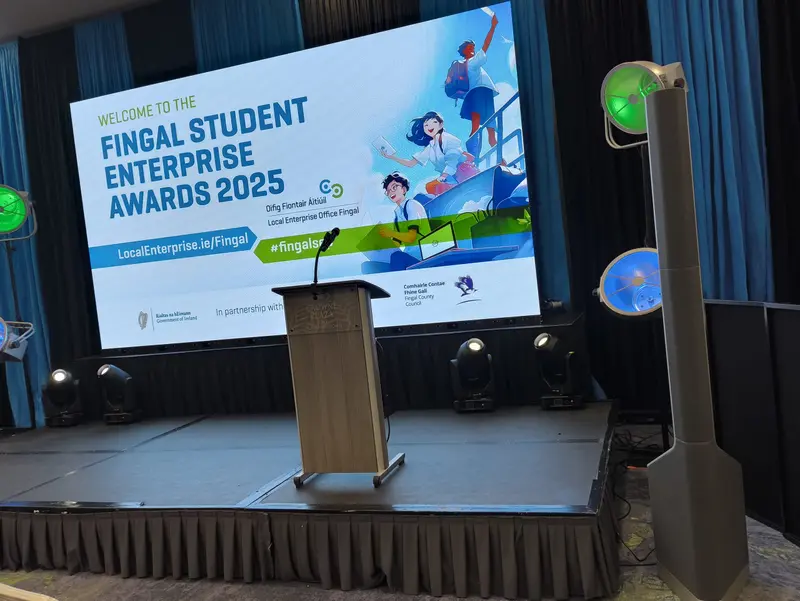
Ask three suppliers for an LED screen and you may get three different descriptions. One may mean a 75" commercial display on a stand. Another may mean a 3.5m × 2m screen built from LED panels. A third may call that same panel-built screen an LED video wall.
That overlap is normal. In event production, LED screen and LED video wall are often two names for the same modular technology: individual LED panels assembled into one seamless display. A single LED screen can be built from panels at 3.5m × 2m, 5m × 3m or another size that suits the stage.
The genuinely different option is a self-contained commercial flat-panel display, usually between 43" and 98", mounted on a stand. This guide explains the difference that actually matters: commercial flat-panel display hire versus a modular LED screen or video wall.
The short answer
Use this as the router. The rest of the guide explains why.
- Boardroom, training day or hybrid meeting: usually one 42"–75" commercial display.
- Conference breakout room: usually one 55"–75" commercial display, repeated across rooms if required.
- Exhibition stand: a 75"–98" commercial display where the audience is close, or a small modular LED screen when the display is part of the stand design.
- Town hall or single-room conference: either two large commercial displays or one modular LED screen, depending on the room and the importance of the stage picture.
- Main conference stage, awards night or product launch: normally one modular LED screen built to the required width and height.
- Outdoor event: a weather-rated modular LED screen designed for daylight and Irish weather.
Audience size helps, but it is not the deciding factor by itself. Viewing distance, room shape, content, available build time and the visual importance of the stage matter more.
What the terms actually mean
Commercial flat-panel display
This is one factory-built display: broadly the commercial version of a television. EventSound supplies screens from 43" to 98" on floor stands, table mounts or suitable wall brackets.
It is quick to install, has a small footprint and works well when viewers are relatively close. One power connection and one video signal can have it operating within minutes.
These displays are often casually called LED screens because they use LED-backlit display technology. For quoting and technical planning, we prefer commercial display or flat-panel display because it avoids confusion with a modular LED system.
Modular LED screen or LED video wall
This is one screen assembled from multiple LED panels. The joins are designed to disappear at normal viewing distance, so the audience sees one continuous picture rather than a grid of separate televisions.
A 3.5m × 2m panel-built display is still a single LED screen. Calling it an LED video wall is also correct. The difference is vocabulary, not equipment.
For many indoor events, a modular screen may be built at roughly 3.5m × 2m through to approximately 5.5m × 3m, depending on the room, sightlines and content. Larger outdoor and arena systems are engineered around the site and audience.
Panels can be ground-supported or rigged, and the finished screen can be flat, curved or formed into a more creative shape. It needs more build time than a commercial display and normally requires a technician, video processing and a proper support system.
When a commercial display is the right call
Commercial displays win when the audience is close, the room is modest and the screen is there to make content legible rather than to become the stage set.
Boardrooms and hybrid meetings are the clearest example. A 55" or 65" display with Teams, Zoom or Google Meet creates a tidy working setup without filling the room with production equipment.
Conference breakout rooms usually need the same approach: slides or a feed from the main room on a display installed before delegates arrive. If a conference uses several breakouts, the same package can be repeated consistently across all of them.
Exhibition stands are another good fit. A bright 75" display at eye level provides strong presentation or video playback in a small footprint and can be removed quickly when the show closes.
Viewing distance matters more than the number printed on the delegate list. For slides and presentation content, the furthest viewer should generally be within roughly six times the image height. A 75" display is about 1 metres high, so it remains useful to around 6 metres for typical presentation content. Beyond that, text and detail begin to lose the back of the room.
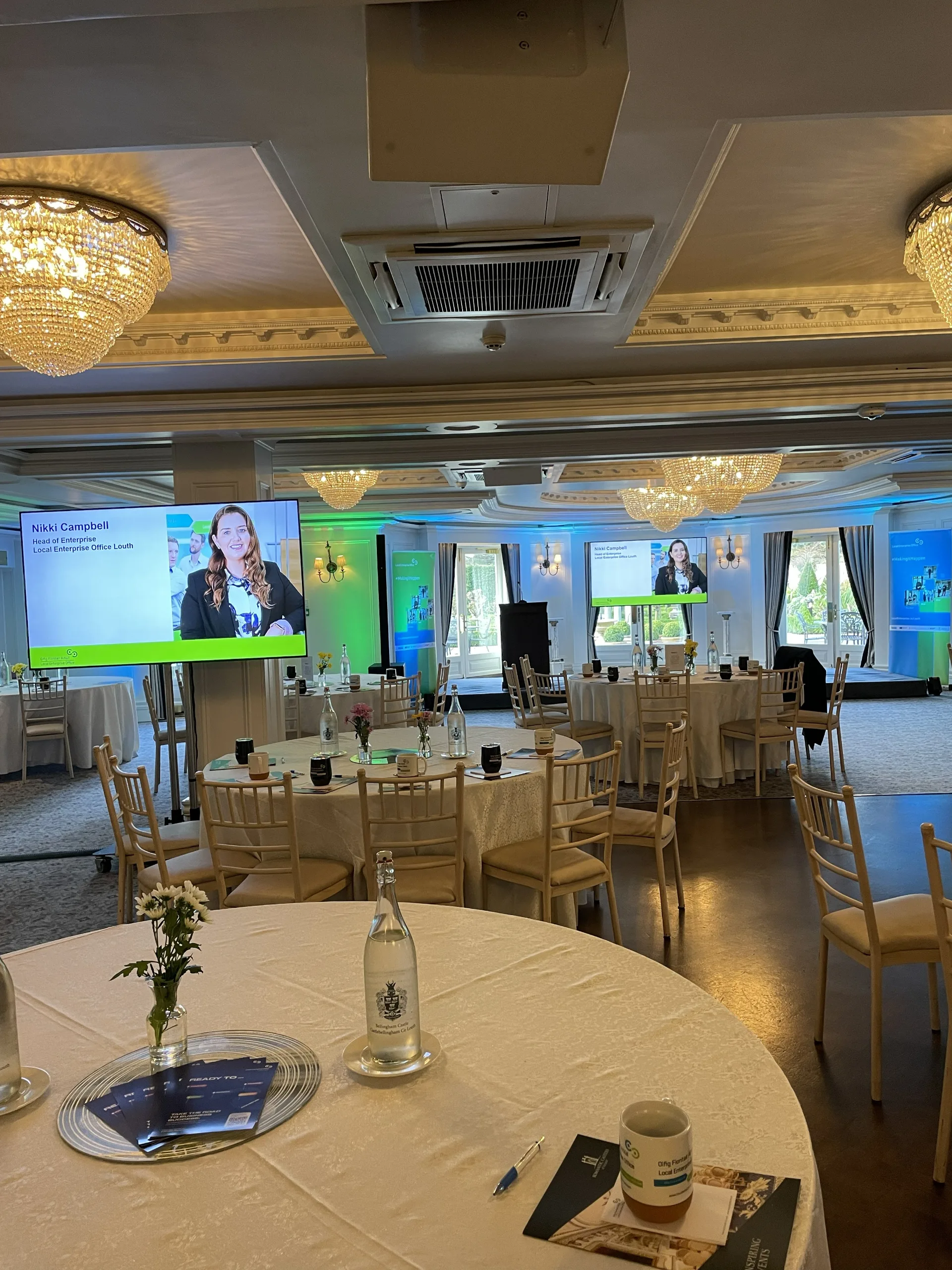
At the Louth LEO Awards 2026 at Bellingham Castle in Castlebellingham, we initially considered one modular LED screen for the room. Sightlines ruled it out.The ballroom has columns and several divided seating areas. Guests at some tables would not have had a clear view of one central screen. We used multiple 75-inch commercial displays around the room, all showing the same live camera feed and presentation content.Every table had a clear view. That mattered more than putting one large screen on the stage.
When a modular LED screen is the right call
A modular LED screen earns its extra build time when the display needs to be larger than a factory-built panel, when it forms part of the stage design, or when the audience and viewing distance demand more image area.
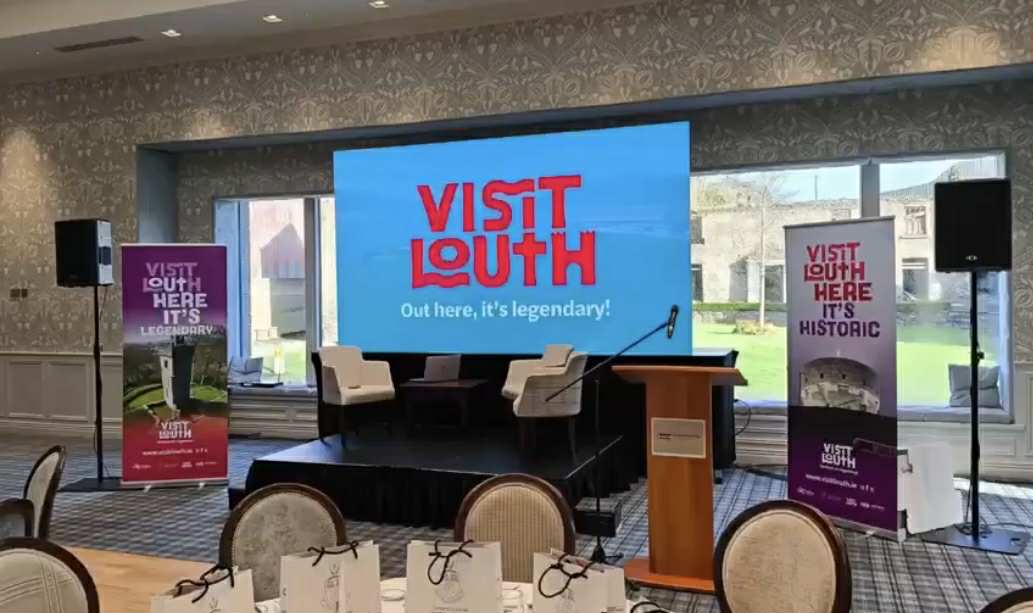
The Visit Louth conference had a similar audience size, but the wide, open room gave everyone a clear view of the stage. A 3.5m × 2m modular LED screen suited it better. Large windows and overhead rooflights brought in plenty of daylight, so the brighter LED display kept the presentation content clear.
Three factors commonly move a job towards modular LED:
Scale. A modular system is built to the image size the room needs rather than the largest size a manufacturer sells as one unit. That makes it suitable for deeper conference rooms, wide stages and audiences spread across a larger space.
The stage picture. At conferences, awards nights and launches, the screen often becomes the set: full-width branding, speaker names, category graphics, sponsor content and video. A modular screen can be proportioned around the stage rather than placed beside it.
Outdoor use. Daylight needs brightness that ordinary commercial displays cannot provide, while rain requires properly weather-rated equipment. The outdoor LED screen used for the Swords Castle Summer Concerts serves more than 8,000 people a night because it is specified around the site, viewing distances and weather exposure.
Pixel pitch determines how close an audience can stand before the panel structure becomes visible. EventSound stocks modular systems across approximately 1.9mm–3.9mm pixel pitches. Our guide to pixel pitch and viewing distance explains how that choice is made.
The real grey area
The genuine either-way job is not defined by a fixed audience number. It is usually a flat-floor conference, town hall or seminar where the audience is close enough for commercial displays, but the organiser wants more visual impact than displays on stands provide.
Two 75" or 98" commercial displays placed either side of the stage can give a wide room excellent coverage with less build time and a lower overall cost. This is often the better answer when the content is mainly presentations and the screens are there for legibility.
A modular LED screen around 3.5m × 2m creates one unbroken central image with significantly more stage presence. It is usually the better answer when the event is a brand moment, will be photographed or filmed, or needs full-width graphics behind presenters.
Neither option is automatically the upgrade. The right choice is the one that buys something the event genuinely needs.
What changes the recommendation
Viewing distance and sightlines
Start with the furthest viewer, not the nearest. A screen that looks generous from the front row may be unreadable at the back. Room depth, seating layout, pillars and ceiling height all affect the recommendation.
Content
Large text and simple presentation slides tolerate a smaller display. Detailed spreadsheets, multi-box hybrid layouts, live camera feeds and sponsor-heavy graphics need more image area.
If a modular screen uses a custom aspect ratio, content should be designed for its exact canvas. Our guide to preparing content for a large LED wall covers aspect ratios, safe areas and playback.
Stage design
Commercial displays normally sit beside or in front of the stage. Modular LED can become the backdrop itself. That difference matters at awards nights, launches and any event where photographs or video will continue representing the event afterwards.
Build time and access
A commercial display can travel through standard doors and be installed quickly. Modular LED arrives as panels, processing, support structure, cabling and cases. Access, floor loading, rigging restrictions and the time available before rehearsal all affect what is practical.
Budget
A commercial display package requires less equipment and labour. A modular LED quote includes more than the visible panels: support or rigging, video processing, transport, installation, testing, operation where required and breakdown.
EventSound's modular LED dry-hire rate is €125 per m² per day as of August 2026. An operated event quote also reflects the build and the technician required to make the system show-ready. If that additional spend does not improve visibility, content or the stage design, we will recommend the commercial displays instead.
LED screen vs LED wall: the useful comparison
| Event requirement | Better starting point | Why |
|---|---|---|
| Boardroom or hybrid meeting | 43"–65" commercial display | Close viewing, quick installation and a small footprint |
| Conference breakout room | 55"–75" commercial display | Easy to repeat across several rooms |
| Exhibition stand | 75"–98" display or small modular LED | Depends on viewing distance and whether the screen forms part of the stand |
| Flat-floor town hall | Two large displays or 3.5m × 2m modular LED | Coverage and budget versus one central stage image |
| Main conference or awards stage | Modular LED screen | Built around the room, sightlines and branding |
| Product launch | Modular LED screen | The display becomes part of the set and photographs well |
| Outdoor audience | Weather-rated modular LED screen | Daylight brightness, scale and weather protection |
Common mistakes
- Treating LED screen and LED wall as completely different technologies. In most event conversations, both terms may describe the same panel-built modular display.
- Calling a commercial display a modular LED screen. It creates confusion at quote stage because the equipment, build time and cost are very different.
- Choosing from audience size alone. A wide room of 100 people and a deep room of 100 people can need different solutions.
- Specifying the screen before checking the content. Dense slides and multi-box video layouts need more image area than a logo or simple presentation.
- Ignoring build access and rehearsal time. A modular screen must be built, processed and tested before content rehearsal begins.
- Assuming the venue's house screen will be sufficient. Check its physical size, brightness, position, inputs and the distance to the furthest viewer.
Frequently asked questions
Are an LED screen and an LED video wall the same thing?
Often, yes. In event production both terms commonly describe one seamless display assembled from modular LED panels. We use both phrases because clients search and ask for both, but we define the actual equipment in every quote.
Can one LED screen be made from multiple panels?
Yes. That is how modular LED screens are constructed. A 3.5m × 2m screen may contain multiple cabinets or panels while operating and appearing as one screen.
What should I call a 43"–98" screen on a stand?
Commercial display, flat-panel display or large-format display are the clearest terms. People may still call it an LED screen, but the more precise wording avoids confusion.
Can one event use both systems?
Yes. A larger conference may use a modular LED screen on the main stage and commercial displays in breakout rooms, at registration or for sponsor content.
What is the smallest modular LED screen worth building?
There is no universal cut-off, but our conference systems commonly start around 6m². Below that point, a 75" or 98" commercial display may provide better value unless the event specifically needs the look of seamless modular LED.
What is included in an EventSound quote?
Our quotes are all-inclusive for the agreed scope: equipment, delivery, installation, on-site operation where required and breakdown. The quote identifies whether the recommendation is a commercial display package or a modular LED system, so there is no ambiguity about what is being supplied.
Planning the display for your event
Send us the venue, room layout, expected audience, stage dimensions and a sample of the content. Phone photographs and a basic floor plan are enough to begin. We will recommend commercial displays or a modular LED screen based on sightlines and the job the display actually needs to do, including the simpler option where it serves the event better.