If someone has told you to "sort the AV" for an event, the first decision is not which screen or which microphone. It's whether you need AV hire or full event production. AV hire supplies, sets up and operates equipment for a plan you have already made. Event production means one team plans and runs the whole technical side (sound, lighting, staging, screens and video) to your running order. Hire answers "what do I need?" once you know. Production answers it for you, and then runs the show. This guide explains what each one covers, how to tell which your event needs, and what to send a supplier to get a quote you can trust.
What AV hire covers
AV hire is the equipment, delivered, set up and run on the day. You, or someone you've asked, decide what's needed: a PA system, a couple of radio microphones, a screen for the presentation. The supplier brings it, installs it, operates it and takes it away afterwards.
Across the trade you will also see dry hire, which means equipment only, with nobody to run it. It is worth checking which one a quote means. Our AV hire service is quoted all-inclusive: equipment, delivery, installation, on-site operation and breakdown.
The hire model works well when three things are true. The event is simple, the plan is clear, and someone on your side can say with confidence what the room needs. If you can describe the job in a few lines, hire is probably the right shape.
Single-element jobs are the clearest examples. At the TG4 Conference in Galway in 2023, our work was an LED screen. At the Music Awards in the Hillgrove Hotel in Monaghan, it was also an LED screen.
What full event production adds
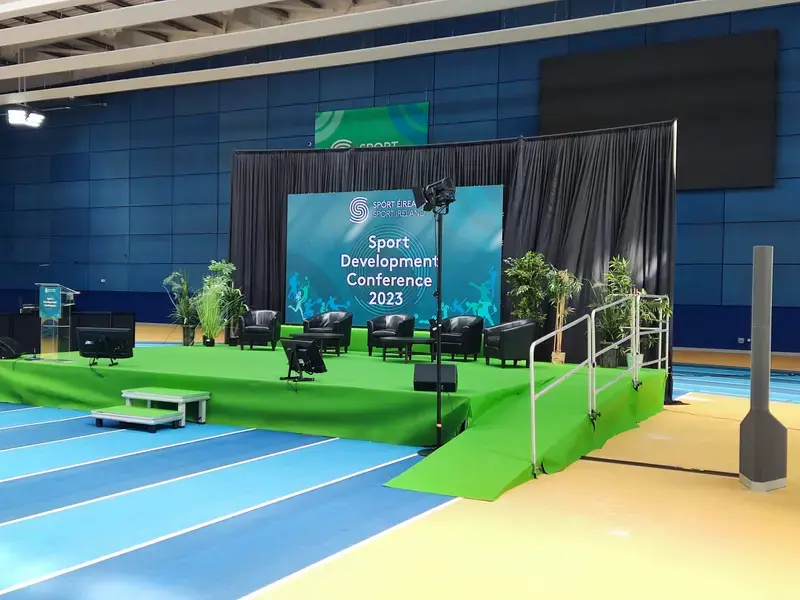
Full event production is a different service, not a bigger version of hire. With event production, one team takes responsibility for the whole technical side of the event. You hand over the running order and the venue. They work out what the show needs.
In practice, full production means:
- Planning the technical side around the running order. Sound, lighting, staging, screens and video are designed together, so the pieces fit each other and the programme.
- A site visit. Someone looks at the room, the access, the power and the sightlines before the specification is fixed. Site visits are free for confirmed bookings.
- A build schedule. Who arrives when, what goes up first, and what has to be finished before doors open.
- Rehearsal. The cues, the presentations and the microphones get tested before the audience arrives.
- Operating the show. The same team runs sound, lighting and vision live, to the running order.
- One point of contact. You talk to one team, not four suppliers who've never met.
The Explore Fingal launch at the Grand Hotel Malahide, a destination tourism brand launch, was full event production. So are the Swords Castle Summer Concerts, which draw 8,000+ attendees per night and combine an outdoor LED screen with the wider production. That's the kind of job production exists for.
AV hire vs event production: the comparison
| AV hire | Full event production | |
|---|---|---|
| Who plans it | You, or someone you appoint | The production team, from your running order |
| Who operates it | A technician, working to your plan | The production team, working to the running order |
| What you need to supply | A clear equipment list and a plan for the day | The running order, the venue and your goals for the event |
| Site visit and build schedule | Only where the job calls for one | Part of the planning |
| Rehearsal | Whatever time you arrange | Built into the schedule |
| Points of contact | One for the kit, others for the rest | One for the whole technical side |
| When it suits | Simple events with a clear plan | Events with several moving parts, or where a failure would be public |
The honest summary is that hire gives you control and asks you to carry the planning. Production takes the planning off you and asks for your running order instead.
How to tell which one you need
Start with the event itself, then ask how much can go wrong.
A board meeting with one screen is a hire job. A training day with a presenter, a lectern and a display needs equipment, set up properly. There's little to coordinate and little that can fail in public. You can specify it in a paragraph.
An awards night is different. You have a stage, lighting states, walk-on music, video playback, several presenters and an audience watching every cue. Each part depends on another. If the timing slips, everyone sees it. That's a production job.
An outdoor concert sits at the far end. Weather, ground, power, crowd sightlines and a screen for thousands of people all need planning together. Nobody should be assembling that from separate hire orders.
A useful test is to ask five questions:
- Can I list everything the room needs, and be confident the list is right?
- Is there a running order with cues, or just one speaker and a screen?
- Does more than one technical area (sound, lighting, video, staging) have to work together?
- Would a fault be public, expensive or embarrassing?
- Do I have time, and someone suitable, to coordinate it?
If the answers are yes, no, no, no and yes, hire will do. If you're answering the other way, you want production. Mixed answers usually mean production for the main event and hire for the simple parts, which is a perfectly normal split.
What to send for a quote
The two services need different information. Send the right things and the quote comes back faster and closer to what you need.
For AV hire, send:
- the date, venue and room
- the number of people attending
- what you want supplied (for example screens, microphones or a PA)
- the start and finish times of the event
- the access and set-up time you've been given
Our conference AV technical brief guide has a template if you want to write it up properly.
For event production, send:
- the date, venue and audience size
- the running order, even a rough one
- the type of event and what it needs to achieve
- any speakers, performers or presentations that need technical support
- anything you already know about the venue, including house equipment
You don't need a technical specification for production. That's the thing you're asking the team to write. If the running order isn't final, say so. A draft is far more useful than silence.
How the quote works
EventSound quotes are all-inclusive. The figure covers equipment, delivery, installation, on-site operation and breakdown, with no hidden fees and no line-item pricing. That applies to AV hire and to full production alike.
The practical benefit is that you compare like with like. A quote that describes the whole job, from arrival to breakdown, is much easier to judge than three that each leave something out. Our guide to what drives conference AV costs explains why two quotes for the same event can look so different, and what to check before you pick the cheaper one.
We don't publish prices for production, because the cost depends entirely on what the event needs. The one published rate is for LED walls hired as panels only, without crew. That's from €125 per m² per day for dry hire of P3 panels, and finer pitches cost more. Everything else is quoted to the job.
Frequently asked questions
What does event AV production include?
It covers the whole technical side of an event, planned together. That means sound, lighting, staging, screens and video, designed around your running order, with a site visit, a build schedule, rehearsal and live operation on the day. You deal with one team and one point of contact rather than coordinating separate suppliers.
Can I start with AV hire and add production later?
Yes, though the earlier you decide, the better. Production is easiest when it shapes the plan from the start, because the running order, staging and screens influence each other. If some equipment is already booked, say so at the start, so the rest can be planned around it. It's a conversation worth having before the details are locked.
Is event production only for large events?
No. Size matters less than complexity. A small awards evening with a stage, lighting and playback can need production more than a larger daytime meeting with one screen. Ask how much has to work together and how visible a failure would be, not how many people are coming.
Do I need to know exactly what equipment I need before I ask?
For hire, it helps, but you can describe the room and the purpose and we'll suggest what fits. For production, you don't. Send the running order and the venue, and the technical plan is our job.
Not sure which side of the line you're on?
Send us the date, the venue, the audience size and the running order (rough is fine) and we'll tell you honestly whether hire will do or production is the safer choice. If it's hire, we'll say so. EventSound is owner-led, with 35+ years of event production experience, and works across Ireland. Talk to us about your event.