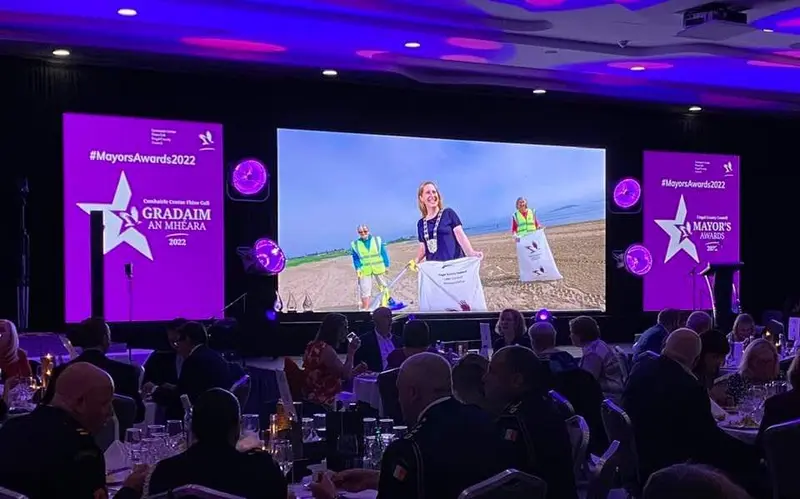
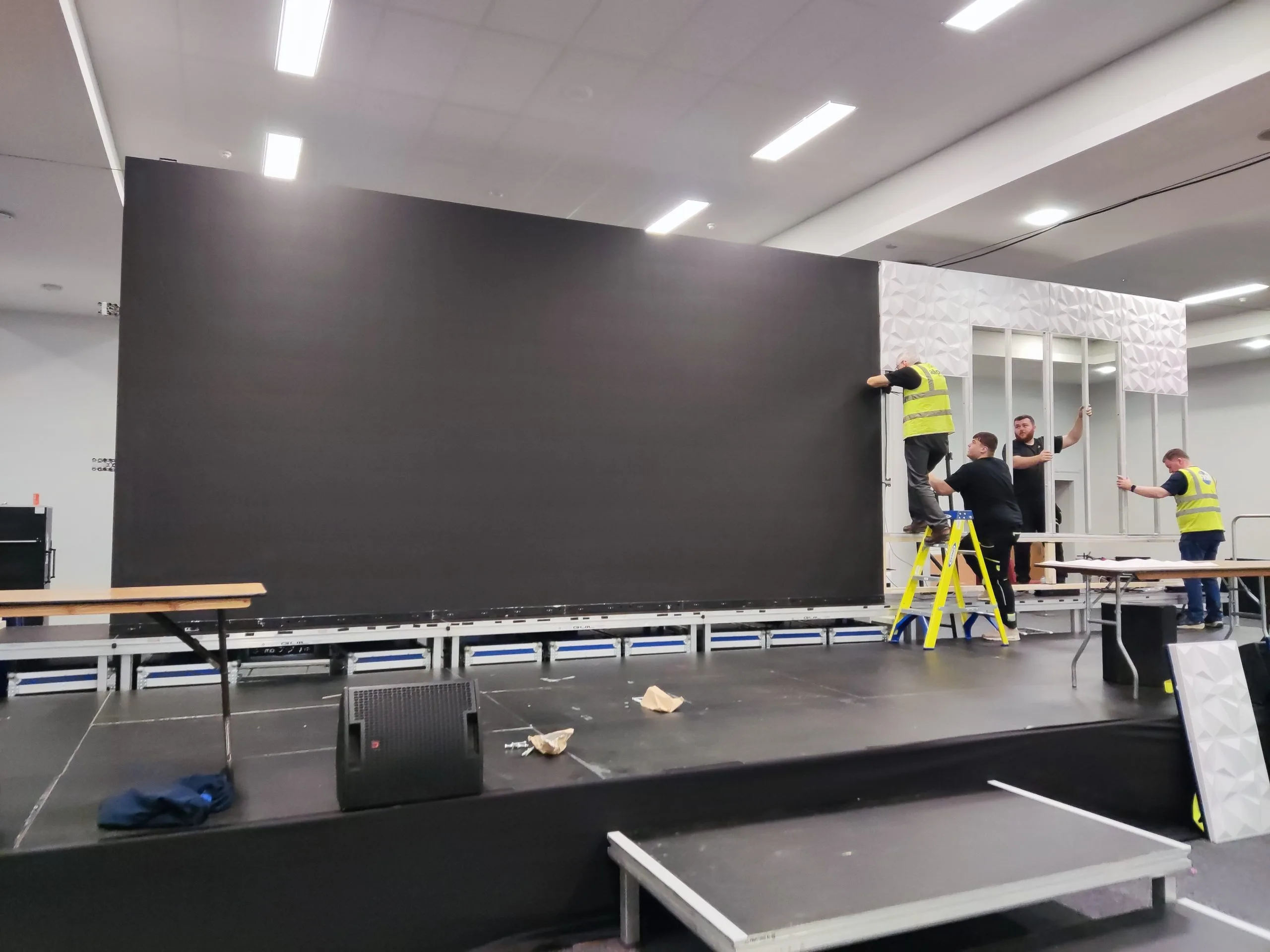
A video wall is built on site, panel by panel. That's the part most people don't picture when they imagine a big screen. Modular LED cabinets click together into one bright surface with no visible joins, at whatever size the room needs, and a processor maps your content across the lot.
Hiring one is handled over on our LED video wall hire page. This article is the explainer behind it. How the panels go together, what sizes events actually use, how a build day runs, roughly what it costs, and what your venue needs to host a wall. One naming point before any of that, because it trips people up. A video wall, an LED video wall, an LED wall and a modular LED screen are all the same product. Suppliers list the same panels under different names.
How a video wall actually works
Most rental panels are half-metre-square cabinets that lock together into a frame, so a wall is assembled in 500mm steps rather than bought in fixed sizes. Each cabinet carries tens of thousands of LED pixels. A video processor stitches the cabinets into one canvas and maps your content across it.
Because every pixel emits its own light, the image holds up in a fully lit room. That's the practical advantage over projection, which fades as the house lights rise. And unlike a bank of televisions, there are no bezels: the joins between panels are invisible at viewing distance, so a five-metre wall reads as one screen, not a grid.
On the day, the wall takes whatever you feed it. Laptop slides over HDMI, playback video, or a live camera mix for bigger rooms. The processor scales each source to the canvas.
Video wall sizes for events
Because walls are modular, "what sizes are there" really means "what size does your room need". Builds step up in half-metre increments, and ours run from 6m² conference backdrops to 50m²+ outdoor screens. The shapes below are the ones event organisers ask for most:
| Build | Area | Where it fits |
|---|---|---|
| 3m × 2m | 6m² | Boardrooms, breakout rooms, product demos |
| 4m × 2.5m | 10m² | The typical single-room conference backdrop |
| 5m × 3m | 15m² | Awards nights, galas and launches |
| 6m × 3.5m | 21m² | Large conferences and wide ballrooms |
| 8m × 5m and up | 40m²+ | Outdoor stages and festival screens |
Two measurements decide the right row on that table. The distance to your furthest viewer sets how big the image must be to stay legible from the back. The ceiling height and stage width cap what physically fits. A three-metre-high wall under a 3.2m ceiling leaves no room for structure.
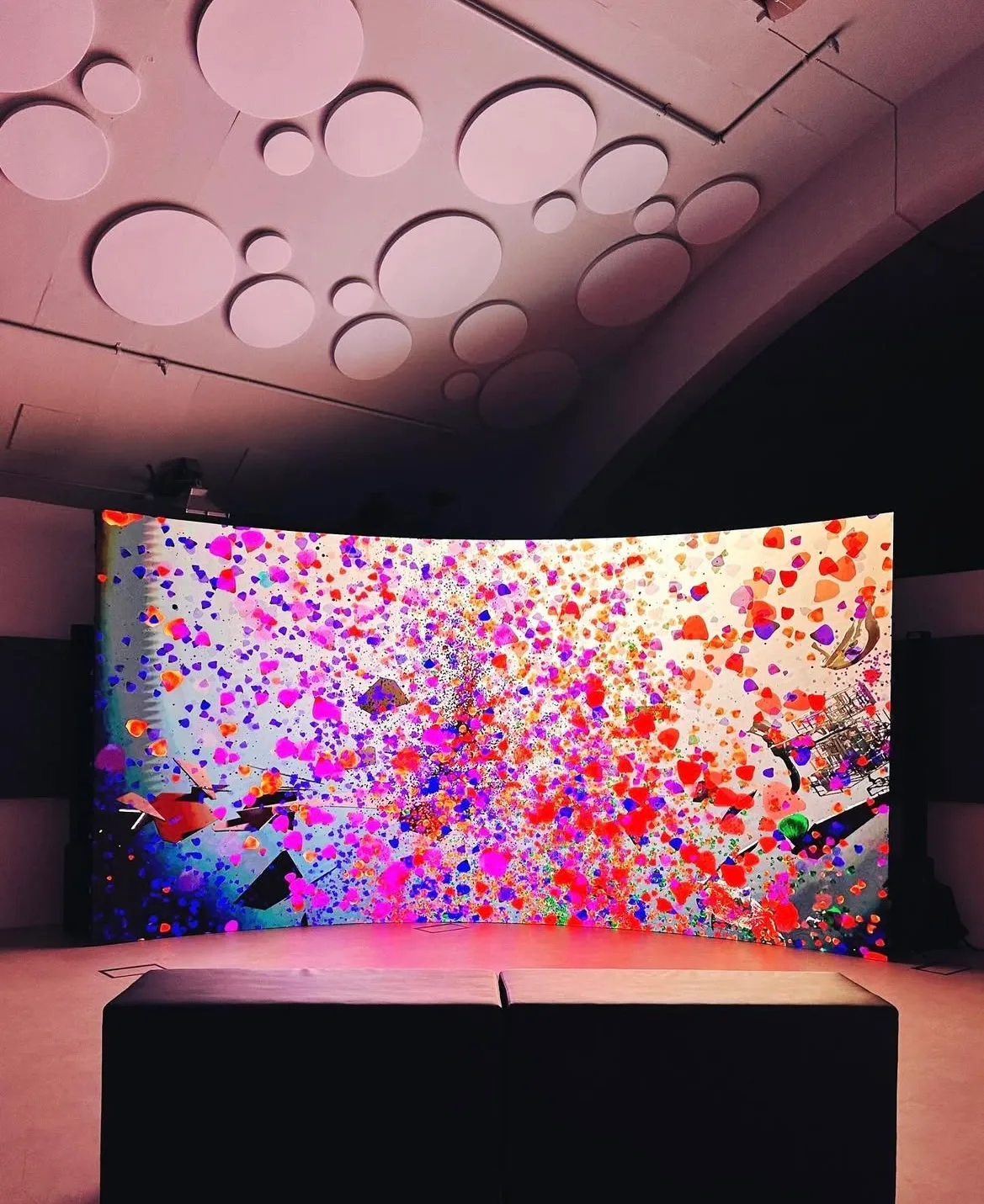
Ratios are flexible. Half-metre panel steps mean a build approximates 16:9 rather than hitting it exactly, and the processor maps standard content onto the canvas cleanly. Nor does a video wall have to be a flat rectangle: curved, angled and custom-shaped builds are all possible. We built a curved video wall for the Beta Festival art and technology exhibition at The Digital Hub in Dublin, shaped to the space rather than propped against a wall.
Pixel pitch, in one paragraph
Pixel pitch is the gap between LED pixels in millimetres, and the rule of thumb is that the pitch equals the minimum comfortable viewing distance in metres. A 2.6mm wall looks solid from about three metres. We stock panels from 1.9mm to 3.9mm: 1.9mm for exhibition stands people walk right up to, 2.6mm as the conference workhorse, and 3.9mm for outdoor stages where the crowd starts further back. If you want the maths and the trade-offs, our guide to pixel pitch and viewing distance covers it without the jargon.
Indoor or outdoor: two different builds
Indoor and outdoor video walls use different panels. It isn't a settings change. Outdoor panels are weather-rated and run far brighter, because they compete with daylight rather than house lighting.
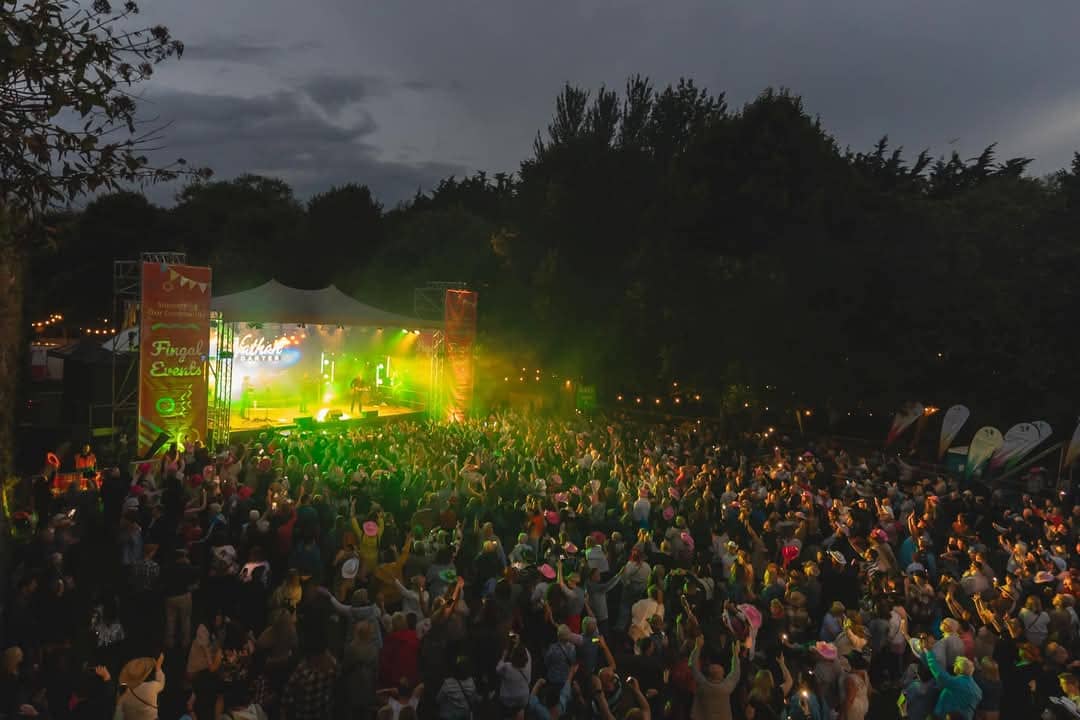
The structure changes too. Indoors, most walls stand on freestanding ground support behind the stage. Where the venue has load-rated rigging points, the wall can fly above it instead. Outdoors, ground-supported structures need ballast and wind planning, and screens step up in size because the audience stands further back. Our outdoor screen for the Swords Castle Summer Concerts played to 8,000+ people a night, with Nathan Carter among the 2025 artists.
What does a video wall cost?
As of August 2026, our published dry hire rate for LED video walls is €125 per square metre per day. That makes the panel maths easy: a 6m² wall is €750 a day, the typical 10m² conference backdrop €1,250, and a 15m² awards wall €1,875.
Dry hire suits production companies with their own crew. Most organisers book an operated package instead, quoted as one all-inclusive figure. That's equipment, delivery, installation, on-site operation and breakdown, with no hidden fees. For scale, a straightforward single-room conference setup with sound and screens starts around €1,500. What moves a real quote beyond the panel price (crew, processing, power, rigging, transport, show duration) is broken down line by line in our guide to LED wall hire costs in Ireland.
How the process works, start to finish
1. Enquiry. Send the venue, room dimensions, audience size, dates and what the wall will carry (slides, video, cameras, sponsor content). Phone photos of the room help more than you'd expect.
2. Specification and quote. You get a recommended size, pitch and placement, and one all-inclusive figure. Site visits are free for confirmed bookings, and one walk-through usually settles power, access and placement questions in a single pass.
3. Build day. The crew loads in, assembles the structure, stacks or flies the panels, cables power and signal, and commissions the processor. You get a finished, tested screen. Not boxes of panels.
4. Show day. An operator runs your content for the duration: cueing slides, switching sources and keeping the picture balanced against the room lighting.
5. De-rig. After the event the wall comes down and the room goes back the way we found it. Build and de-rig windows are agreed with the venue in advance, including overnight or early-morning slots where the turnaround is tight.
What your venue needs to host a video wall
- Floor space or rigging points. A ground-supported wall needs a level footprint behind the stage and floor loading to match. A flown wall needs load-rated rigging points and venue sign-off.
- Power. Small indoor walls can run from ordinary house circuits. Larger builds need three-phase supplies. The requirement is confirmed against your actual venue before build day.
- Access. Door widths, lifts, stairs, loading bays and parking all shape the build schedule. Flag anything awkward early.
- Time in the room. A wall is assembled on site, so the schedule needs a realistic build window before doors and a de-rig slot afterwards.
- Content. Slides and video built for the wall's canvas, ideally checked in advance rather than on the morning.
Common video wall mistakes
- Sizing from the budget instead of the back row. A wall the last row cannot read is decoration. Size from the furthest viewer, then trim cost elsewhere.
- Forgetting the ceiling. Room height caps wall height once structure is added. Measure before you fall for a render.
- Content built for a laptop. Hairline fonts and dense slides that read on a 15-inch screen dissolve on a four-metre canvas. Build for the screen you booked.
- Leaving power to the last minute. Venue supply questions are cheap to answer at the site visit and expensive on build day.
- Comparing quotes on panel price alone. Crew, processing, transport and operation vary between suppliers far more than the panels do. Check what each figure includes.
Frequently asked questions
Is a video wall the same thing as an LED wall?
Yes. Video wall, LED wall, LED video wall and modular LED screen all describe the same panel-built product. The only genuinely different option is a bank of individual televisions, which costs less but shows visible bezels between screens.
Do we need to operate it ourselves?
Only on dry hire. Operated packages include delivery, installation, an operator for the show and breakdown afterwards, quoted as one figure.
How far ahead should we book?
As soon as your dates firm up. Autumn conference season and the pre-Christmas run concentrate demand, and the best build slots go first.
Where do you deliver?
Anywhere in Ireland. Dublin, Cork, Galway, Belfast, Limerick and everywhere between. Delivery and installation are part of every hire.
Get a size and a price for your room
Send us the room dimensions, audience size and dates, and we'll come back with a recommended wall size, pixel pitch and placement, plus one all-inclusive figure with nothing hidden in it. EventSound is owner-led, with 20+ years of event production across Ireland. Tell us about your event.